
The methods and experiences for avoiding delays and delivering quickly are:
Through five key measures, delivery time can be shortened by 40% -60%, and fast delivery can be achieved without sacrificing quality:
1. Choose a CNC machining plant equipped with advanced equipment, automated processes, and efficient project management;
2. For complex shaft components, priority should be given to using a walking machine, which significantly reduces the number of processes and clamping times;
3. Optimize Design for Manufacturability (DFM) by simplifying the structure, ensuring reasonable tolerances, and selecting materials that are easy to purchase and process;
4. Simplify communication processes and use digital tools to improve quotation, decision-making, and collaboration efficiency;
5. Implement Vendor Managed Inventory (VMI) and safety stock for long-term demand to eliminate the impact of delivery time.
Ultimately, the delivery time can be reduced from weeks to days, while improving quality, reducing total costs, and enhancing production agility.
You can reduce CNC machining lead times by 40-60% through strategic partnership selection, optimized design for manufacturability, material standardization, leveraging Swiss turning technology for complex parts, and choosing factories with automated workflows and real-time communication systems. The key is working with a CNC machined parts factory that combines advanced equipment, efficient processes, and dedicated project management to deliver the best parts faster without compromising quality.
The Lead Time Crisis in CNC Machining
In today’s fast-paced manufacturing landscape, long machining lead times create serious competitive disadvantages. Whether you’re developing new products, replacing critical components, or managing production schedules, delays in receiving custom CNC turned parts ripple through your entire operation—causing missed deadlines, increased carrying costs, and frustrated customers.

The Cost of Long Lead Times
Financial Impact
- Expedited shipping costs: $500-2,000 per shipment for rush orders
- Production line downtime: $10,000-50,000+ per day
- Opportunity costs: Delayed product launches and lost market share
- Inventory carry costs: Higher buffer stocks needed to compensate for unreliable lead times
Operational Challenges
- Extended time-to-market for new products
- Inability to respond quickly to customer demand changes
- Increased complexity in production planning and scheduling
- Reduced flexibility and agility in manufacturing operations
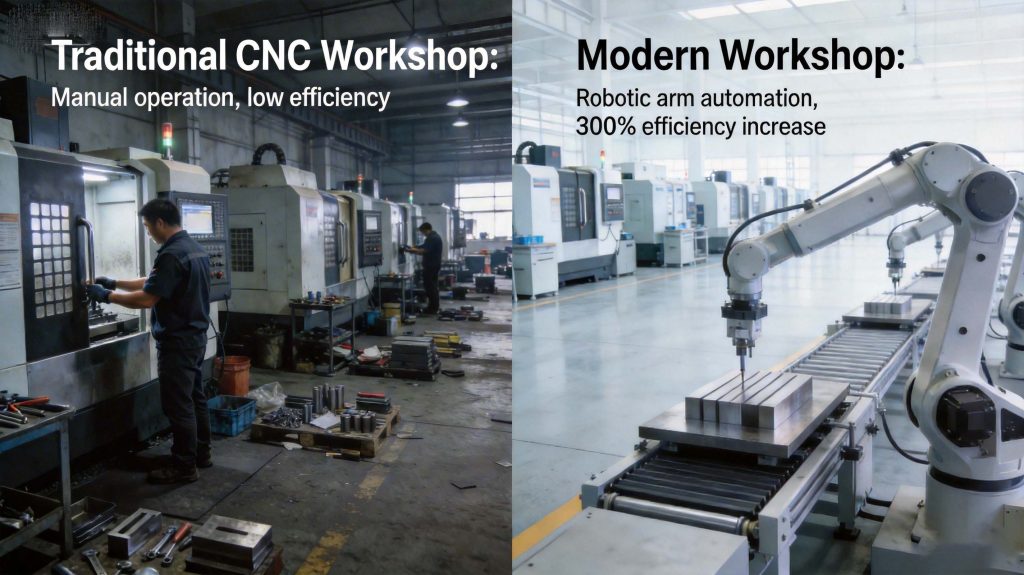
Why Lead Times Vary Dramatically Between CNC Machined Parts Factories
Understanding lead time variations starts with recognizing that not all CNC machining operations are created equal. The difference between a 4-week lead time and a 10-day delivery often comes down to specific capabilities and operational practices:
Equipment Technology Gap
- Traditional manual setups vs. automated workholding systems
- Single-spindle machines vs. multi-spindle and Swiss turning centers
- Conventional 3-axis vs. advanced 5-axis CNC systems
- Outdated control systems vs. modern CNC with real-time monitoring
Process Efficiency Factors
- Manual programming vs. CAM software with simulation
- First article inspection processes that delay production starts
- Reactive maintenance vs. preventive maintenance programs
- Manual material handling vs. automated loading systems
Communication Bottlenecks
- Limited project management and customer service availability
- Slow quotation processes with multiple back-and-forth cycles
- Unclear documentation and revision control systems
- Time zone and language barriers in overseas partnerships
Strategy #1: Partner with the Right CNC Machined Parts Factory
The single most impactful decision you can make to accelerate delivery is choosing the right manufacturing partner. The best parts factories prioritize speed as a core competency rather than treating rapid delivery as an exception.
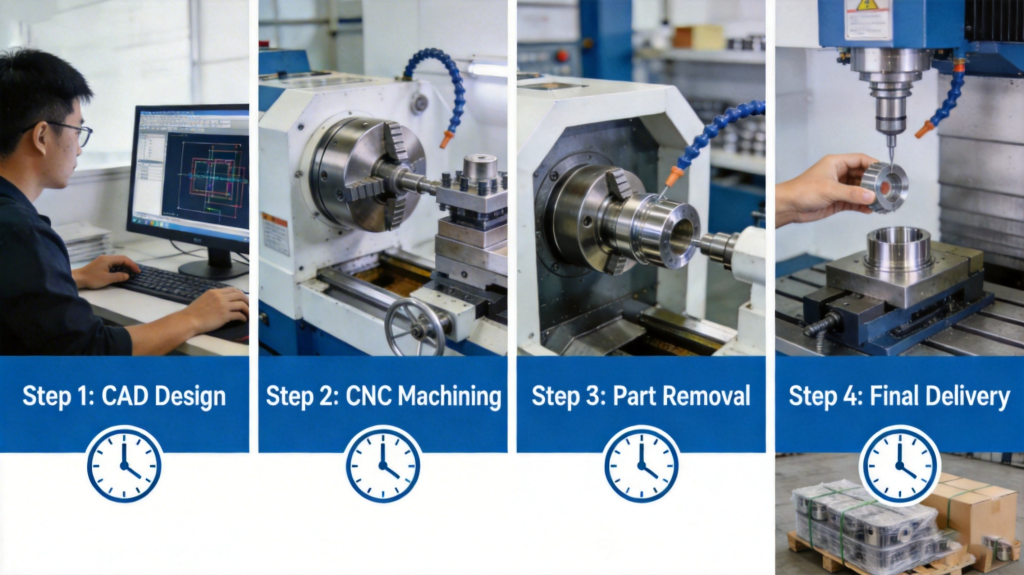
Essential Capabilities for Fast Delivery
Modern Equipment Fleet
A CNC machined parts factory equipped with state-of-the-art machinery dramatically reduces cycle times and setup times. Key equipment indicators include:
- Swiss turning machines for complex cylindrical parts with secondary operations
- Multi-axis CNC machining centers (4- and 5-axis) for reduced setups
- Automated bar feeders enabling unattended overnight operation
- Quick-change tooling systems minimizing setup downtime
- Robotic loading systems for continuous production
Production Capacity and Flexibility
Look for factories with:
- Redundant equipment capacity to handle rush orders without disrupting production
- Multiple shift operations (24/7 capabilities)
- Scalable operations for prototype through production volumes
- Dedicated rapid prototyping capabilities
Quality Systems Built for Speed
Quality control shouldn’t slow down production. The best CNC machined parts factories implement:
- First article inspection processes that don’t delay production starts
- Statistical process control (SPC) systems for proactive quality monitoring
- In-process inspection capabilities to catch issues before parts complete
- Documented quality systems (ISO 9001) ensuring consistency
Red Flags: Factories That Will Delay Your Parts
Outdated Technology
- Equipment older than 10 years without modernization
- Lack of CNC simulation and offline programming capabilities
- Manual setup and changeover procedures
- No investment in automation or digital manufacturing
Capacity Constraints
- Limited machine diversity (only basic 3-axis equipment)
- Single-shift operations with no overtime flexibility
- No capacity buffers for rush orders
- Over-reliance on subcontracting for secondary operations
Communication Problems
- Slow quotation response times (more than 48 hours)
- Limited technical engineering support during design phases
- Inadequate project management and tracking systems
- Poor documentation and revision control
Strategy #2: Leverage Swiss Turning for Complex Parts
Swiss turning represents one of the most significant advancements in rapid manufacturing of precision turned parts. This technology, originally developed for watchmaking, excels at producing complex cylindrical components with exceptional speed and precision.
What Makes Swiss Turning Special
Unlike conventional CNC turning where the workpiece is supported at one or both ends, Swiss turning machines guide the workpiece through a guide bushing. This provides exceptional support close to the cutting tool, enabling:
- Simultaneous operations: Multiple tools can cut simultaneously
- Excellent accuracy: ±0.0001″ (0.0025mm) tolerance capabilities
- Complex geometries: Off-center holes, cross-drilling, and milling in one operation
- Long, slender parts: Excellent support for high length-to-diameter ratios
- Reduced secondary operations: Many features completed in a single setup
When Swiss Turning Accelerates Delivery
Complex Cylindrical Parts
Swiss turning dramatically reduces lead times for parts requiring:
- Multiple diameter changes along the length
- Cross-drilled holes and slots
- Off-center features
- Threaded sections and milled flats
- Complex milling operations on turned components
High-Precision Requirements
For applications demanding tight tolerances, Swiss turning:
- Eliminates multiple setups that accumulate errors
- Provides exceptional process capability (Cpk > 1.33)
- Reduces inspection time due to consistent quality
- Enables same-day delivery for high-precision parts
Production Quantities
Swiss turning excels at:
- Prototype through production volumes without retooling
- Rapid changeovers between different part designs
- Consistent quality across production runs
- Low setup times enabling small batch viability
Real-World Speed Improvements
Case Study: Medical Device Component
Traditional CNC turning approach:
- Multiple operations: Turning, milling, drilling, threading
- 4 machine setups required
- 3-week lead time
- Higher risk of tolerance stack-up
Swiss turning solution:
- Single operation, multiple simultaneous tools
- Completed in one machine setup
- 5-day lead time
- Consistent quality from single operation
Result: 83% reduction in lead time with improved quality and reduced risk
Strategy #3: Optimize Design for Faster Machining
Even the best CNC machined parts factory cannot deliver parts quickly if the design creates unnecessary manufacturing complexity. Design for Manufacturability (DFM) practices focused on speed can dramatically reduce both machining time and lead time.
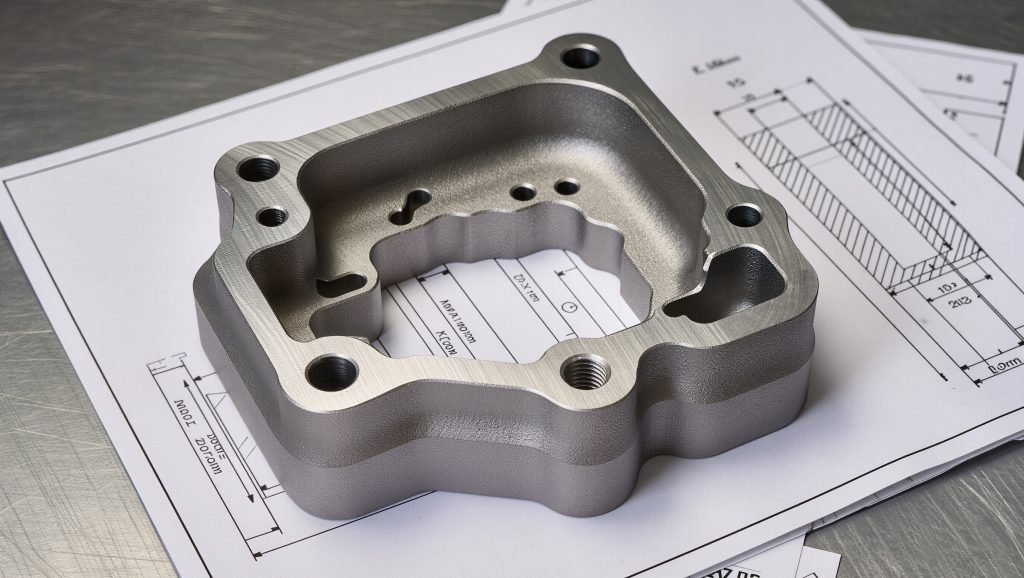
Design Principles for Rapid Delivery
Simplify Geometry
Complex geometries multiply setup requirements and machining time. Speed-focused design principles include:
- Eliminate unnecessary features: Every surface that doesn’t need machining should be left as-cast, as-forged, or with standard finishes
- Consolidate features: Where possible, combine multiple features into single, more efficient operations
- Use standard sizes: Design around standard tool sizes and material dimensions
- Avoid deep narrow cavities: These require specialized tooling and conservative machining parameters
Optimize Tolerances Appropriately
Every decimal place of additional precision exponentially increases both machining time and lead time:
- Default to loosest acceptable tolerances: ±0.005″ (0.127mm) is often sufficient for many applications
- Apply tight tolerances selectively: Only specify tighter tolerances where functionally necessary
- Avoid blanket tolerances: Specify different tolerances for different features based on requirements
- Consider functional gauging: Design parts so they can be verified quickly with functional gauges rather than detailed measurements
Material Selection for Speed
Material choice significantly impacts both machining speed and availability:
- Choose readily available materials: Aluminum 6061, 304/316 stainless steel, and 12L14 steel are stocked by most suppliers
- Consider machinability ratings: Highly machinable materials can be produced 30-50% faster
- Standardize materials: Using the same material across multiple parts reduces setup and programming time
- Avoid exotic materials without justification: Titanium and superalloys dramatically increase lead times and cost
The Speed-DFM Checklist
Before submitting your design to any CNC machined parts factory, review this checklist:
Geometry Optimization
- Are there any features that can be eliminated without affecting function?
- Can multiple features be consolidated into simpler geometries?
- Are all radii and fillets appropriate for standard tooling?
- Have you avoided deep, narrow cavities and fragile walls?
Tolerance Review
- Have you specified the loosest acceptable tolerances for non-critical dimensions?
- Are tight tolerances justified by functional requirements?
- Can you use functional gauging instead of detailed dimensioning?
- Are geometric tolerances specified appropriately to prevent tolerance stack-up?
Material Selection
- Is the material readily available from standard suppliers?
- Have you considered alternative materials with better machinability?
- Can material standardization reduce changeover time across multiple parts?
- Are there any exotic materials that could be replaced with more conventional alternatives?
Strategy #4: Streamline Communication and Processes
Communication delays often represent the hidden bottleneck in CNC machining lead times. Optimizing how you work with your manufacturing partner can shave days or even weeks off delivery times.
Accelerate the Quotation Phase
The quotation process sets the timeline for your entire project. Best practices for speed include:
Complete Initial Submissions
- Provide complete 3D CAD models (STEP, IGES, or Parasolid formats)
- Include detailed 2D drawings with all dimensions and tolerances
- Specify material requirements clearly (grade, heat treatment, surface finish)
- Define quantity requirements and delivery expectations upfront
Technical Detail Upfront
- Clearly mark critical dimensions and tolerances
- Provide functional requirements and assembly information
- Identify any previous issues or special considerations
- Include design history or revision notes if applicable
Clarify Expectations
- State your delivery timeline requirements explicitly
- Define what “acceptance” means for the project
- Clarify reporting and communication preferences
- Establish approval processes for any required changes
Enable Fast Decision-Making
Empowered Project Team
- Designate a single point of contact for all project communications
- Empower team members to make technical decisions quickly
- Establish clear authority levels for approvals
- Ensure team availability during critical decision points
Proactive Issue Resolution
- Establish protocols for handling technical questions and change requests
- Define timelines for responding to manufacturing partner inquiries
- Pre-approve reasonable design for manufacturability suggestions
- Create contingency plans for potential material or manufacturing challenges
Documentation and Tracking
- Implement clear documentation standards for revisions and approvals
- Use shared project management systems when available
- Maintain complete records of all communications and decisions
- Track project milestones and delivery commitments
Leverage Digital Collaboration Tools
File Sharing and Collaboration
- Use secure, cloud-based file sharing platforms
- Implement version control for design revisions
- Enable real-time collaboration on design reviews
- Maintain backup copies of all project files
Project Tracking Systems
- Request access to manufacturer’s project tracking systems
- Set up automated status notifications for key milestones
- Use shared calendars for critical deadlines
- Implement visual dashboards for project status
Digital Approvals
- Implement electronic approval processes for design changes
- Use digital signature systems for formal documentation
- Create standardized approval forms and checklists
- Maintain audit trails for all approvals
Strategy #5: Implement Just-in-Time Inventory Strategies
For ongoing needs, strategic inventory management can virtually eliminate lead time impact on your operations while maintaining the quality advantages of custom CNC machined parts.
Vendor-Managed Inventory (VMI) Programs
How VMI Works
VMI partnerships allow your CNC machined parts factory to maintain inventory of your frequently used parts and manage replenishment based on your consumption patterns. Key advantages include:
- Immediate availability: Parts are ready when you need them
- Reduced inventory carrying costs: Your manufacturer bears inventory costs
- Predictable supply: Automated replenishment prevents stockouts
- Economies of scale: Manufacturer can produce parts in optimal batch sizes
Implementation Considerations
- Identify high-usage parts suitable for VMI
- Establish minimum and maximum inventory levels
- Define consumption reporting requirements
- Implement automated reorder triggers
Cost-Benefit Analysis
While VMI requires some inventory commitment, the benefits typically include:
- Elimination of lead time for VMI items
- Reduced total inventory costs across the supply chain
- Improved production scheduling flexibility
- Lower transaction costs (fewer individual purchase orders)
Strategic Safety Stock Programs
For critical components that cannot be managed through VMI, maintaining strategic safety stock provides insurance against lead time variability:
Identify Critical Items
- Single-source components with long lead times
- Parts that would shut down production if unavailable
- Custom milled parts with unique geometries not easily substituted
- High-usage components where stockouts create significant costs
Calculate Optimal Safety Stock Levels
- Analyze historical usage patterns and variability
- Consider supplier lead time reliability
- Factor in cost of stockouts vs. inventory carrying costs
- Adjust based on seasonality and demand patterns
Implement Reorder Point Systems
- Establish automatic reorder triggers when stock falls to defined levels
- Build lead time buffers into reorder point calculations
- Regularly review and adjust parameters based on actual performance
- Monitor and improve forecast accuracy over time
Selecting the Best Parts Manufacturing Partner
With these strategies in mind, evaluating potential CNC machined parts factory partners requires specific focus on capabilities and practices that enable rapid delivery.
Key Questions for Fast Delivery
Equipment and Technology
- What types of CNC equipment do you operate? (Look for Swiss turning, multi-axis machines, automated systems)
- What is your average setup time for typical parts?
- Do you have redundant capacity for rush orders?
- What automation and process control systems do you have in place?
Lead Time Capabilities
- What are your standard lead times for parts similar to mine?
- What’s the fastest delivery you’ve achieved for similar complexity?
- Do you offer expedited options? What’s the additional cost?
- What percentage of your orders are delivered on time?
Quality Systems
- What quality certifications do you hold?
- How do you handle first article inspection without delaying production?
- What statistical process control systems do you have in place?
- How do you ensure quality while maintaining rapid delivery?
Communication and Project Management
- What project management systems do you use?
- How quickly can you provide quotations for new projects?
- What’s your typical response time for technical questions?
- Can I access project status information online?
Customer Service and Support
- Will I have a dedicated project manager?
- What are your engineering support capabilities?
- How do you handle design changes and modifications?
- What’s your process for handling quality issues or non-conforming parts?
Warning Signs of Slow Deliveries
Be cautious about CNC machined parts factories that display these red flags:
- Reluctance to commit to specific delivery dates
- Limited transparency about current capacity and workload
- Outdated equipment and facilities
- Poor communication and slow response times
- High rates of quality issues requiring rework
- Inability to provide references from similar industries
- Lack of documented quality systems and processes
- Heavy reliance on manual operations rather than automation
Case Study: Reducing Lead Times from 6 Weeks to 10 Days
A medical device manufacturer was consistently experiencing 6-week lead times for critical precision turned parts, causing production delays and expedited shipping costs.
Challenge Analysis
The manufacturer was working with multiple suppliers, each specializing in different operations:
- Primary turning: 3 weeks
- Secondary operations: 1.5 weeks
- Plating and finishing: 1.5 weeks
- Quality inspection and logistics: Additional time
Solution Implementation
The manufacturer partnered with a single-source CNC machined parts factory offering:
- Swiss turning capabilities for complex cylindrical parts
- In-house secondary operations (milling, drilling, tapping)
- Integrated quality inspection processes
- Dedicated rapid prototyping capabilities
- Real-time project tracking and communication
Results Achieved
- Lead time reduction: From 6 weeks to 10 days (76% reduction)
- Quality improvement: First-pass yield increased from 89% to 97%
- Cost savings: Eliminated expedited shipping costs totaling $25,000 annually
- Production flexibility: Enabled same-day delivery for emergency replacements
Key Success Factors
- Single-source partnership eliminated inter-supplier coordination delays
- Swiss turning technology consolidated multiple operations into single processes
- Integrated quality processes prevented inspection bottlenecks
- Dedicated project management ensured rapid decision-making
Conclusion: Speed Without Sacrificing Quality
Long machining lead times aren’t inevitable. By implementing these five strategic approaches—partnering with the right CNC machined parts factory, leveraging Swiss turning technology, optimizing design for manufacturability, streamlining communication, and implementing smart inventory strategies—you can dramatically accelerate delivery times while maintaining or even improving quality.
The path to rapid delivery requires intentionality from the initial design phase through partnership selection and ongoing collaboration. When executed thoughtfully, the result is more than just faster parts—it’s improved operational agility, reduced total costs, and competitive advantage in your market.
Key Takeaways for Rapid Delivery
- Choose partners strategically: Not all CNC machined parts factories prioritize speed—select one with modern equipment, automation, and proven rapid delivery capabilities
- Leverage appropriate technologies: Swiss turning and multi-axis machining dramatically reduce complex parts delivery times
- Design for manufacturability: Simplified geometries, appropriate tolerances, and material standardization significantly accelerate production
4. Streamline communication: Fast, clear communication and empowered decision-making eliminate hidden delays
5. Implement smart inventory strategies: VMI and strategic safety stock eliminate lead time impact for ongoing needs
The best parts manufacturers understand that speed is a competitive advantage. By choosing the right partner and optimizing your approach, you can achieve delivery times measured in days rather than weeks—without compromising quality or precision.
Frequently Asked Questions (FAQ)
What’s the fastest delivery time possible for custom CNC turned parts?
For simple parts with standard materials and moderate tolerances, the fastest delivery times range from 3-5 business days. Complex parts with Swiss turning or secondary operations may require 7-10 business days. Emergency rush orders can sometimes be completed in as little as 48 hours for qualified existing customers with simple parts.
Does faster delivery mean higher costs?
Not necessarily. While expedited services often carry premium pricing, working with efficient CNC machined parts factories that prioritize rapid delivery as a standard capability can provide fast lead times without significant cost premiums. Additionally, faster delivery often reduces total cost through lower inventory carrying costs and reduced expedited shipping needs.
How does Swiss turning compare to conventional CNC turning for delivery speed?
Swiss turning typically reduces lead times by 50-70% for complex cylindrical parts compared to conventional CNC turning. This is because Swiss turning machines can perform multiple operations simultaneously in a single setup, eliminating the need for multiple machines and setups that conventional turning requires.
Can I get overnight delivery for CNC machined parts?
Yes, but overnight delivery is typically only possible for:
- Simple parts that can be machined quickly
- Repeat orders where programming and setup are already complete
- Existing customers with established quality systems
- Parts that meet FedEx/UPS overnight shipping size and weight restrictions
What’s the difference between a standard delivery and expedited service?
Standard delivery times vary by manufacturer but typically range from 2-6 weeks depending on part complexity and current workload. Expedited service prioritizes your order in the production queue, often through overtime shifts and dedicated resources, reducing delivery to 3-7 business days. Expedited services typically cost 20-50% more but may still be more economical than the cost of production delays.
How can I ensure consistent quality with rapid delivery?
Quality and speed aren’t mutually exclusive when working with the right CNC machined parts factory. Key practices include:
- First article inspection processes integrated into production start
- Statistical process control for proactive quality monitoring
- Documented quality systems (ISO 9001 certification)
- Clear specifications and approved design for manufacturability
- Partner selection based on proven quality capabilities
What information do I need to provide for the fastest quotation?
For the fastest quotation response, provide:
Functional requirements and any special considerations
Complete 3D CAD models (STEP, IGES, or Parasolid)
Detailed 2D drawings with all dimensions and tolerances
Material specifications and any required heat treatment or surface finish
Quantity requirements and delivery timeline expectations
- Tired of Long Machining Lead Times? How to Get Custom CNC Turned Parts Delivered Faster
- Why CNC Machining Is So Expensive (And How to Cut Costs by 30%)
- Why Robotic End-Effectors Require Specialized CNC Micro-Machining?
- What? Does it only take 10 minutes to charge an electric car? China’s tram megawatt flash charging technology
- How to achieve aerospace-grade precision in consumer-priced Optimus parts?

 Italian
  English
  French
  German
  Spanish
  Portuguese
  Russian
  Arabic
  Japanese