
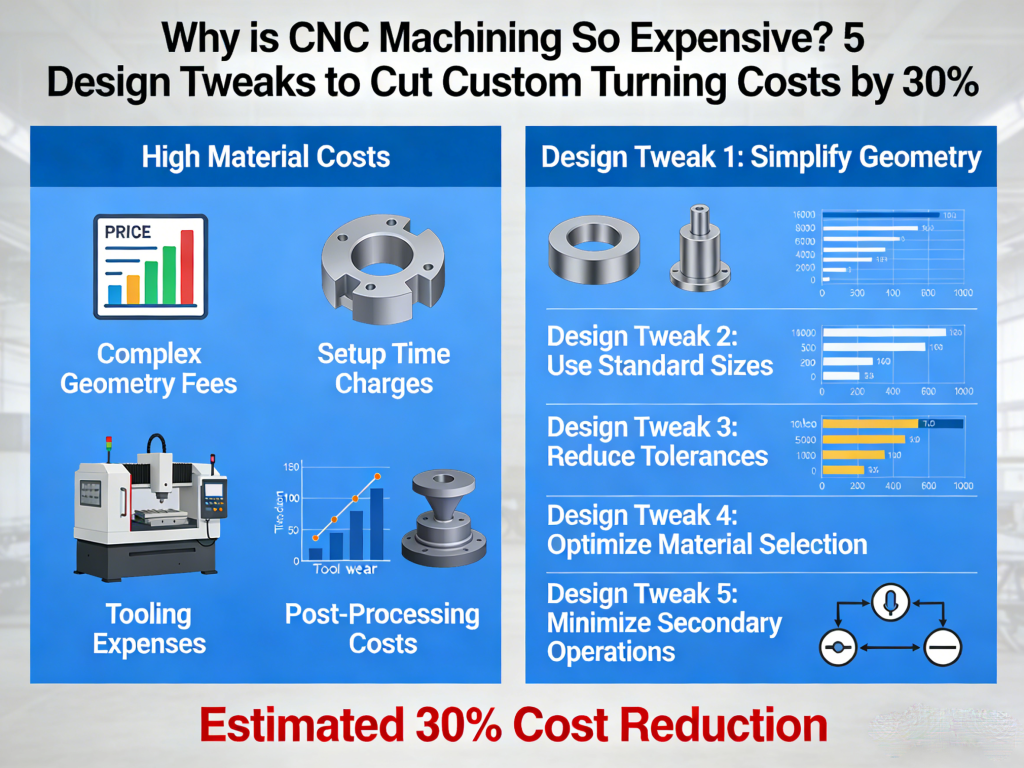
CNC machining is expensive primarily due to high machine operation costs ($150-300/hour), skilled labor requirements, extensive setup time, and tool wear. However, strategic design optimizations—including radius internal corners, larger tolerances, simplified geometry, standard materials, and optimized surface finishes—can reduce custom turning costs by up to 30% while maintaining quality and functionality.
Understanding CNC Machining Costs: The Breakdown
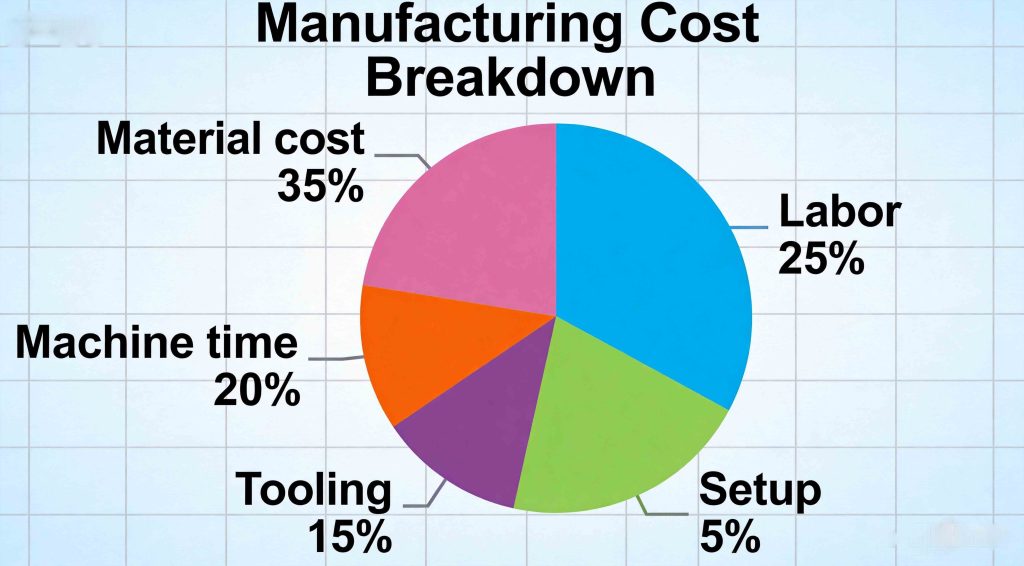
Before diving into cost-saving strategies, it’s essential to understand what drives CNC machining expenses. CNC turning and milling aren’t just about raw material costs—they involve complex processes that require precision equipment, skilled operators, and meticulous quality control.
cylinder part in industrial workshop with modern precision equipment
Primary Cost Components
Machine Time and Labor (45-50% of total cost)
CNC machines represent significant capital investments, with high-end 5-axis machining centers costing $500,000-$1 million. Operating costs typically range from $150-300 per hour, including electricity, maintenance, and machine depreciation. Skilled CNC programmers and operators command competitive salaries, particularly for complex parts requiring advanced programming expertise.
Material Costs (25-30% of total cost)
While material costs seem straightforward, they encompass more than just raw stock. Factors include:
- Raw material prices (titanium and exotic alloys can cost 10-20x more than aluminum)
- Material waste from machining (up to 60% material removal for some parts)
- Scrap rates and quality losses
Tooling and Setup (15-20% of total cost)
Every new part requires specialized tooling, fixtures, and setup procedures. Complex parts may require multiple tool changes, special cutters, and custom fixturing—each adding to the bottom line. Setup time can range from 1-8 hours depending on part complexity, during which the machine produces no revenue.
Quality Control and Inspection (5-10% of total cost)
Precision requirements demand rigorous inspection processes. CMM (Coordinate Measuring Machine) time, first article inspections, and statistical process control all contribute to the final cost, especially for industries like aerospace and medical devices where tolerances reach ±0.001mm.
Design Tweak #1: Add Radius to Internal Corners
Sharp internal corners are among the most significant cost drivers in CNC machining. The fundamental issue: cutting tools are cylindrical, creating a natural radius at the bottom of any hole or pocket.
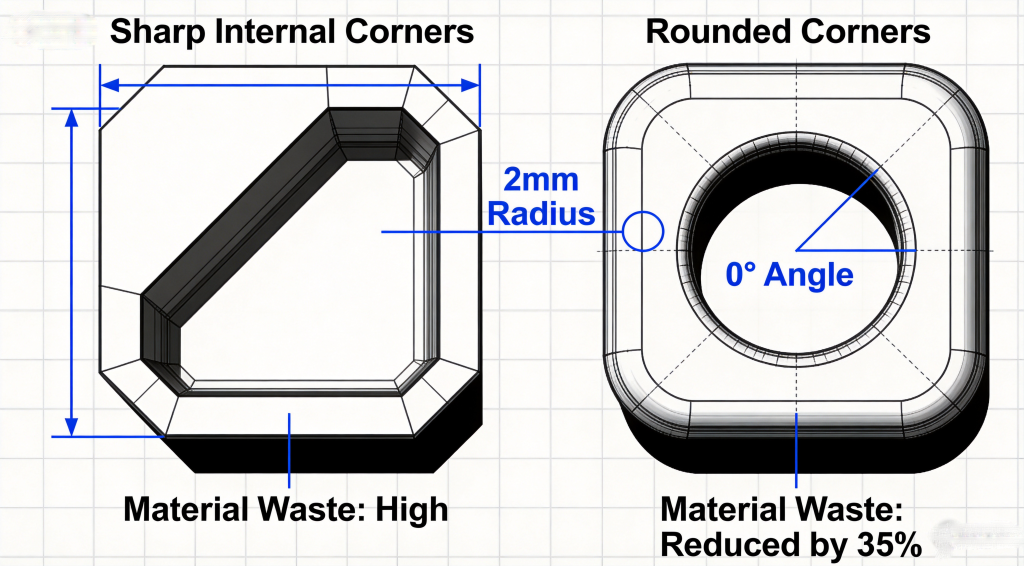
Why Sharp Corners Increase Costs
Machining a sharp internal corner requires multiple operations:
- End milling: Creates the initial radius-limited pocket
- Wire EDM or smaller tools: Additional processes to reach the corner
- Multiple setups: Often require repositioning the workpiece
This adds machining time (2-5x longer per corner), increases tool wear, and introduces potential accuracy issues from multiple setups.
The Cost-Saving Solution
Add internal radii matching standard tooling sizes:
- Standard end mills: 1/16″ (1.5875mm), 1/8″ (3.175mm), 3/16″ (4.7625mm), 1/4″ (6.35mm)
- Minimum recommended radius: 0.5 × material thickness
- Corner radius ≥ tool radius for efficient single-pass machining
Cost Impact: Adding appropriate radii can reduce machining time by 30-50% for parts with multiple internal corners, directly translating to proportional cost savings.
Implementation Example:
- Before: 90° internal corners requiring 4-hour wire EDM operation
- After: 1/8″ radius corners completed in 1 hour with standard end mill
- Savings: 75% reduction in corner machining time
Design Tweak #2: Optimize Tolerances Appropriately
Tight tolerances dramatically increase CNC machining costs, yet many designs specify precision levels that exceed actual functional requirements.
The Tolerance-Cost Relationship
Machining costs increase exponentially as tolerances tighten:
| 許容範囲 | Cost Multiplier | Typical Applications |
|---|---|---|
| ±0.005″ (0.127mm) | 1.0x | General purpose parts |
| ±0.002″ (0.051mm) | 1.5x | Precision machinery |
| ±0.001″ (0.025mm) | 2.0x | Aerospace components |
| ±0.0005″ (0.013mm) | 3.0x+ | Medical implants |
Why the dramatic increase?
- Slower cutting speeds: Tight tolerances require conservative machining parameters
- Multiple passes: Additional roughing and semi-finishing operations
- Specialized tooling: Higher-quality cutters with minimal deflection
- Enhanced inspection: More frequent and detailed quality checks
Strategic Tolerance Assignment
Apply tight tolerances only where necessary:
- Critical surfaces: Bearing journals, sealing surfaces, mating surfaces
- Loose tolerances elsewhere: Non-contacting surfaces, cosmetic areas, non-critical dimensions
Practical Guidelines:
- Default to ±0.005″ (0.127mm) unless tighter tolerance is justified
- Specify ±0.001″ (0.025mm) only for truly critical dimensions
- Avoid blanket tolerances on entire drawings
- Consider geometric dimensioning and tolerancing (GD&T) for complex parts
Real-World Savings:
A custom shaft part originally specified at ±0.001″ throughout:
- Revised: Critical journal at ±0.0005″, remaining dimensions at ±0.005″
- Result: 25% reduction in machining time and tooling costs
- Quality maintained: All functional requirements met
Design Tweak #3: Simplify Part Geometry
Complex part geometries directly increase CNC machining costs through multiple factors: additional machine setups, specialized tooling, longer cycle times, and higher scrap rates.
Cost-Adding Geometry Features
Deep narrow cavities (depth > 4× width):
- Require specialized long-reach tools with deflection issues
- Multiple passes with light cuts increase machining time
- Vibration risks affect surface quality
- Cost impact: 2-3x standard cavity machining
Undercuts and reverse tapers:
- Require specialized tooling (T-slot cutters, dovetail cutters)
- Often need additional setups or special fixturing
- Reduce machining rigidity and accuracy
- Cost impact: Additional $200-800 per undercut feature
Thin walls and fragile features:
- Require conservative machining parameters
- Increased risk of scrap (10-20% scrap rates common)
- Multiple fixtures and support structures
- Cost impact: 30-50% higher for fragile parts
Geometry Optimization Strategies
Consolidate features where possible:
- Combine multiple parts into single components
- Reduce total number of machined surfaces
- Minimize orientation changes
Design for manufacturability:
- Maintain uniform wall thickness (minimum 2× material thickness)
- Avoid aspect ratios > 4:1 for unsupported walls
- Add generous fillets at junctions
- Consider adding sacrificial supports for machining
Use standard machine capabilities:
- Design within 3-axis machining when possible (5-axis costs 30-50% more)
- Keep part size within machine envelope (larger parts require larger, more expensive machines)
- Avoid features requiring manual finishing
Case Study: Automotive Bracket Redesign
- Original: Complex 3D curved surfaces, 5-axis machining required, $85/part
- Redesign: Simplified planar surfaces, 3-axis machining sufficient, $52/part
- Savings: 39% cost reduction while maintaining all functional requirements
Design Tweak #4: Choose Cost-Effective Materials
Material selection significantly impacts CNC machining costs beyond raw material price, affecting tool wear, machining speeds, and overall processing time.
Material Machinability and Cost Impact
Highly Machinable Materials (Cost Multiplier: 1.0x):
- Aluminum 6061/7075: Fast cutting speeds, minimal tool wear
- Brass (C36000): Excellent chip formation, low tooling costs
- Free-machining steels (1215, 12L14): Optimized for machining
Moderately Machinable Materials (Cost Multiplier: 1.5-2.0x):
- Stainless steel 304/316: Work hardening issues, slower speeds
- Carbon steel 1018/1045: Standard machinability
- Magnesium alloys: Fast machining but fire safety requirements
Difficult-to-Machine Materials (Cost Multiplier: 2.0-4.0x):
- Titanium alloys (Ti-6Al-4V): Low thermal conductivity, high strength
- Nickel alloys (Inconel 718): Extreme heat and wear resistance
- Tool steels (H13, P20): Hard, require specialized tooling
- Superalloys: Often require grinding rather than machining
Strategic Material Selection Guidelines
Match material properties to requirements:
- Use aluminum where weight savings and adequate strength suffice
- Select stainless only when corrosion resistance is critical
- チタンと超合金は、真に要求の厳しい用途のために取っておく。
被削性評価を考慮してください。
- ASTMの被削性評価は、標準化された比較基準を提供する。
- 評価が高いほど、加工コストは低くなります。
- 例:アルミニウム6061(100%定格)対チタン(15-20%定格)
材料費と加工費のバランスを取る:
- 高価な材料を使うと、加工速度が速くなるため、全体のコストが削減される場合がある。
- 総コストを計算します:(材料費×数量)+(加工率×サイクルタイム)
- 例:快削鋼はコストが20%高くなるが、加工時間を40%短縮できる。
コスト最適化の例:
医療機器の筐体は、当初316ステンレス鋼で製造されていました。
- 材料費:$15/個、加工時間:45分、合計:$52.50/個
- 代替案:適切なコーティングを施した6061アルミニウム:$8/個、加工時間:15分、合計:$23.75/個
- 節約額:機能要件を満たしながら55%のコスト削減を実現
設計変更#5:表面仕上げ要件の最適化
表面仕上げ仕様(Ra値)は、追加工程、加工速度の低下、検査要件の増加などを通じて、CNC加工コストに直接影響を与える。
表面仕上げコスト階層
標準機械加工仕上げ(Ra 125~250μin / 3.2~6.3μm):
- 標準的な荒加工および半仕上げ加工中に達成される
- 追加の操作は不要です。
- コストへの影響:ベースライン
精密機械加工仕上げ(Ra 63~125μin / 1.6~3.2μm):
- 専用の仕上げ工程が必要
- 切削速度を遅くし、切削深さを小さくする
- コストへの影響:20~30%の増加
精密仕上げ(Ra 32~63μin / 0.8~1.6μm):
- 複数の仕上げ工程
- 専用工具と慎重なパラメータ選択
- コストへの影響:50~75%の増加
超精密仕上げ(Ra < 32 μin / < 0.8 μm):
- 研磨、ホーニング、またはポリッシングが必要な場合が多い
- 追加の作業と設備
- コストへの影響:100%+の増加
戦略的な表面仕上げ仕様
機能的な箇所にのみ、しっかりとした仕上げを施してください。
- 接触面(ベアリング、シール):Ra 32以上
- 美容関連部位:Ra値63~125で十分
- 重要度の低い表面:標準的な機械加工仕上げで十分
機能要件と美観を比較検討する:
- 機能仕様と外観要件を分離する
- 加工精度の向上よりも、外観の改善を目的とした後処理(研磨、コーティング)を行う。
平面と複雑な曲面:
- 平面は経済的に仕上げやすい
- 複雑な曲面には特殊な技術が必要となる
- 仕上げ面を最適化するために再設計を検討する
材料固有の考慮事項:
- アルミニウム:適切な工具を使用すれば、良好な仕上がりを実現できる。
- ステンレス鋼:加工硬化は表面仕上げの均一性に影響を与える
- チタン:仕上げ加工中の焼き付きリスク
コスト削減の例:
油圧マニホールド部品:
- オリジナル:すべての表面はRa 32と指定され、部品1個あたりの総コストは$85です。
- 最適化済み:重要なシール面Ra 32、その他の面Ra 125、総コスト$58/部品
- 節約額:機能を維持しながら32%のコスト削減
製造性を考慮した設計(DFM)の導入
これら5つの設計変更を体系的に実施するには、製造性を考慮した設計(DFM)の原則を採用する必要があります。これは品質を犠牲にするということではなく、設計要件と製造経済性との関係を最適化するということです。
DFMプロセス統合
早期のコラボレーション:
- 設計段階から製造パートナーと連携する
- 設計を最終決定する前に、DFMレビューを実施する。
- コスト要因に関するメーカーの専門知識を活用する
費用対効果分析:
- 各設計変更によるコスト削減額を定量化する
- 機能性およびパフォーマンスへの影響を評価する
- ライフサイクルコスト(初期製造コストと総所有コスト)を考慮する
文書および仕様書:
- 重要な寸法と表面を明確にマークする
- GD&Tを使用して要件を正確に定義する
- 重要でない機能の過剰な仕様指定は避ける
成功の測定
コスト削減指標:
- 目標:20~30%の総コスト削減が達成可能
- 追跡項目:部品単価、セットアップ時間、工具費、不良率
- ベンチマーク:最適化された設計を以前のバージョンと比較する
品質指標:
- 初回通過歩留まりを維持または向上させる
- 寸法変動を低減する
- 生産工程全体の一貫性を向上させる
リードタイムの改善:
- セットアップ時間の短縮と作業工程の削減により、配送時間が短縮されます。
- シンプルな設計により、より迅速な見積もりが可能になります。
- 複雑さを軽減することで、ペナルティなしでより小さなバッチサイズが可能になります。
結論:戦略的コスト最適化
CNC加工のコストは高額ですが、決して不変ではありません。機械稼働時間、人件費、段取り費用、工具費、品質管理といった基本的なコスト要因を理解することで、機能性や品質を損なうことなくコストを大幅に削減できる、情報に基づいた設計判断が可能になります。
今回紹介した5つの設計上の工夫――内角に丸みを加える、公差を最適化する、形状を簡素化する、費用対効果の高い材料を選択する、表面仕上げ要件を最適化する――を総合的に行うことで、カスタム旋削加工のコストを最大30%削減できます。これらは安易な近道ではなく、製造現場の実情に基づいた戦略的な設計最適化です。
主なポイント:
- 機能性だけでなく、製造性も考慮した設計:製造上の制約を早期に検討することで、コスト削減につながる。
- 精密さを戦略的に適用する:厳しい公差と精緻な仕上げは、真に重要な表面と寸法に限定する
- 標準ツールとプロセスを活用する:標準機能を中心に設計することで、コストを大幅に削減できます。
4.製造パートナーと早期に連携する:彼らの専門知識によって、設計が最終決定される前に最適化の機会を特定できる。
5. 総コストを考慮する:材料費、加工時間、セットアップ要件、品質管理を相互に関連する要素として考える
最も効果的なコスト最適化策は、エンジニアリング要件と製造経済性のバランスを取るものです。これらの設計戦略を慎重に適用することで、コスト削減だけでなく、製造性の向上、品質の一貫性の強化、納期の短縮にもつながります。
よくある質問(FAQ)
費用対効果の高いCNC加工を行うための最小注文数量はどれくらいですか?
CNC加工は少量生産でも費用対効果に優れています。セットアップ費用は全部品に分散されるため、数量が増えるにつれて部品あたりのコストは下がりますが、最低注文数量の制限はありません。試作品(1~10個)は通常、部品あたりのコストが高くなりますが、量産前に設計の妥当性を検証することができます。
許容誤差が厳しすぎるかどうかは、どうすればわかりますか?
各寸法の機能要件を確認してください。寸法が部品の組み立て、性能、または規制遵守に直接影響しない場合は、より緩い公差(±0.005インチ以上)の使用を検討してください。特定の用途に適した公差レベルについてガイダンスを提供できる製造パートナーに相談してください。
1つのCNC加工部品に異なる材料を混ぜて使用することはできますか?
はい、しかしこれは通常、一体加工ではなく組み立て作業を必要とします。異なる材料を別々に加工し、溶接、締結具、または圧入によって組み立てることができます。この方法は、異種材料を一緒に加工しようとするよりも、多くの場合、費用対効果に優れています。
3軸CNC加工と5軸CNC加工では、コスト面でどのような違いがありますか?
5軸加工は、機械コストの高さ、プログラミングの複雑さ、段取り時間の長さなどから、一般的に3軸加工よりも30~501TP高くなっています。しかし、複雑な部品の場合、5軸加工によって段取り回数を減らすことができるため、総コストを削減できます。最も先進的な技術にこだわるのではなく、部品の複雑さに基づいて選択することが重要です。
表面仕上げは部品の機能にどのような影響を与えるのか?
表面仕上げは、摩擦、摩耗、流体の流れ、および外観に大きく影響します。シール面、ベアリング、および可動部品には、より緻密な仕上げ(Ra値の低い仕上げ)が不可欠です。構造面や化粧面には、粗い仕上げでも十分な場合が多く、加工コストを大幅に削減できます。
同じ部品設計を維持しながら、異なる材料を使用することでコストを削減できますか?
多くの場合そうですが、決定には慎重な分析が必要です。材料強度、耐食性、熱特性、および規制要件を考慮してください。アルミニウムなどの材料は一般的にチタンや超合金よりも加工コストが安いですが、すべての機能要件を満たすとは限りません。徹底的な費用対効果分析が不可欠です。
CNC加工コストの最適化をお考えですか?
これらのコスト削減戦略を理解することが第一歩です。それらを効果的に実施するには、具体的な設計の最適化に関する実践的なガイダンスを提供できる経験豊富な製造パートナーとの連携が不可欠です。
これらの原則を次回のCNC加工プロジェクトに適用するための専門的なアドバイス、またはコスト最適化に関する推奨事項を含む無料の設計レビューをご希望の場合は、CNC旋削加工とフライス加工の工学的側面と経済的側面の両方を理解している精密製造の専門家にご相談ください。

 Japanese
  English
  French
  Italian
  German
  Spanish
  Portuguese
  Russian
  Arabic